 GiftCoves
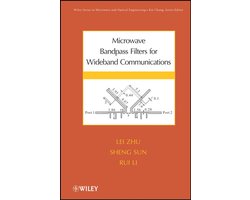
Wiley Series in Microwave and Optical Engineering 232 - Microwave Bandpass Filters for Wideband Communications
bij 1 winkel
Verwant
Streepjescode: 9781118197974

Alle aanbiedingen
- bol.comWiley Series in Microwave and Optical Engineering 232 - Microwave Bandpass Filters for Wideband CommunicationsNaar de winkel€ 115,99Op voorraad
We verdienen mogelijk commissie als je via deze link koopt. Wat jij betaalt verandert niet.
Over dit product
This book will appeal to scientists and engineers who are concerned with the design of microwave wideband devices and systems. For advanced (ultra)-wideband wireless systems, the necessity and design methodology of wideband filters will be discussed with reference to the inherent limitation in fractional bandwidth of classical bandpass filters. Besides the detailed working principles, a large number of design examples are demonstrated, which can be easily followed and modified by the readers to achieve their own desired specifications. Therefore, this book is of interest not only to students and researchers from academia, but also to design engineers in industry. With the help of complete design procedures and tabulated design parameters, even those with little filter design experience, will find this book to be a useful design guideline and reference, which can free them from tedious computer-aided full-wave electromagnetic simulations. Among different design proposals, wideband bandpass filters based on the multi-mode resonator have demonstrated many unparalleled attractive features, including a simple design methodology, compact size, low loss and good linearity in the wide passband, enhanced out-of-band rejection, and easy integration with other circuits/antennas. A conventional bandpass filter works under single dominant resonant modes of a few cascaded transmission line resonators and its operating bandwidth is widened via enhanced coupling between the adjacent resonators. However, this traditional approach needs an extremely high coupling degree of coupled-lines while producing a narrow upper stopband between the dominant and harmonic bands. As a sequence, the desired dominant passband is restricted to an extent less than 60% in fractional bandwidth. To…
Omschrijving aangeleverd door bol.com.