 GiftCoves
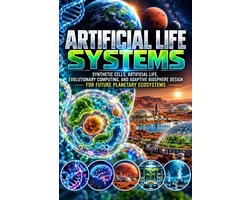
Artificial Life Systems: Synthetic Cells, Artificial Life, Evolutionary Computing, and Adaptive Biosphere Design for Future Planetary Ecosystems
dans 1 boutique
À voir aussi
Code-barres: 9798237010640

Toutes les offres
- bol.comArtificial Life Systems: Synthetic Cells, Artificial Life, Evolutionary Computing, and Adaptive Biosphere Design for Future Planetary EcosystemsVoir la boutique8,99 €En stock
Nous pouvons percevoir une commission si vous achetez via ce lien. Le prix que vous payez ne change pas.
À propos de ce produit
How do living systems emerge, evolve, and remain stable—and what can artificial life teach us about the possibility of sustainable habitats beyond Earth? Artificial Life Systems: Synthetic Cells, Artificial Life, Evolutionary Computing, and Adaptive Biosphere Design for Future Planetary Ecosystems explores the connections between biology, computation, ecology, and planetary science. From synthetic cells and minimal genomes to digital organisms and virtual ecosystems, this book examines the tools researchers use to investigate life's fundamental processes. Artificial life research brings together several distinct approaches: constructing simplified biological systems, simulating evolution in computers, and studying how complex behavior emerges from interacting components. Understanding these approaches can illuminate the relationship between molecular mechanisms, adaptation, and ecological organization. Their possible applications to future space habitats also raise questions about resource limits, environmental compatibility, and long-term stability. Inside, you'll explore: - The foundations of artificial life: Self-organization, emergence, complex adaptive systems, and the challenges of defining life. - Synthetic and minimal cells: Biological membranes, molecular information, genome replication, metabolism, and cellular homeostasis. - Evolution and adaptation: Natural selection, population genetics, adaptive landscapes, and the conditions that shape evolutionary change. - Evolutionary computing: Genetic algorithms, swarm intelligence, digital organisms, and computational approaches to optimization. - Biological networks: Gene regulation, metabolic pathways, cellular communication, and interactions across multiple scales. - Ecosystem dynamics: Food webs, biodiversity,…
Description fournie par bol.com.